Healthcare copywriting is working when the right patients find your practice and book with it. That's the whole test. Everything worth measuring sits somewhere between the search and the scheduled visit, and private practice healthcare copywriting has to earn its keep there, not in compliments from your office manager.
Copywriting is writing meant to get someone to act. For a clinic, that act is almost always a call, a form, or a booked visit. So that's where we start counting.
I'm Riley, a freelance healthcare copywriter in Spokane. I've spent five-plus years writing for independent clinics, and I track these numbers with my clients because I'd rather show you the work paid off than ask you to take my word for it.
TL;DR Quick Answers
Private Practice Healthcare Copywriting
Private practice healthcare copywriting is marketing writing for independent and small practices. It covers website and service pages, SEO content, and patient email, written in the practice's own voice so the right patients find it and book.
Who it's for: solo and small practices, from direct primary care and family medicine to PT, mental health, and specialty clinics.
What sets it apart: one writer learns your voice from your reviews and the way you talk, instead of an agency filling in a clinical template.
How to tell it's working: appointment requests and calls per page, measured against your own 90-day baseline.
Where to start: the website first, then SEO content, then email.
What to expect: website changes can show up within weeks, and SEO content usually takes three to six months to climb.
One rule carries the rest: the copy is working when the right patients book.
Top 5 Takeaways
Judge copy by booked appointments. Calls and form requests per page are the clearest sign your words are working.
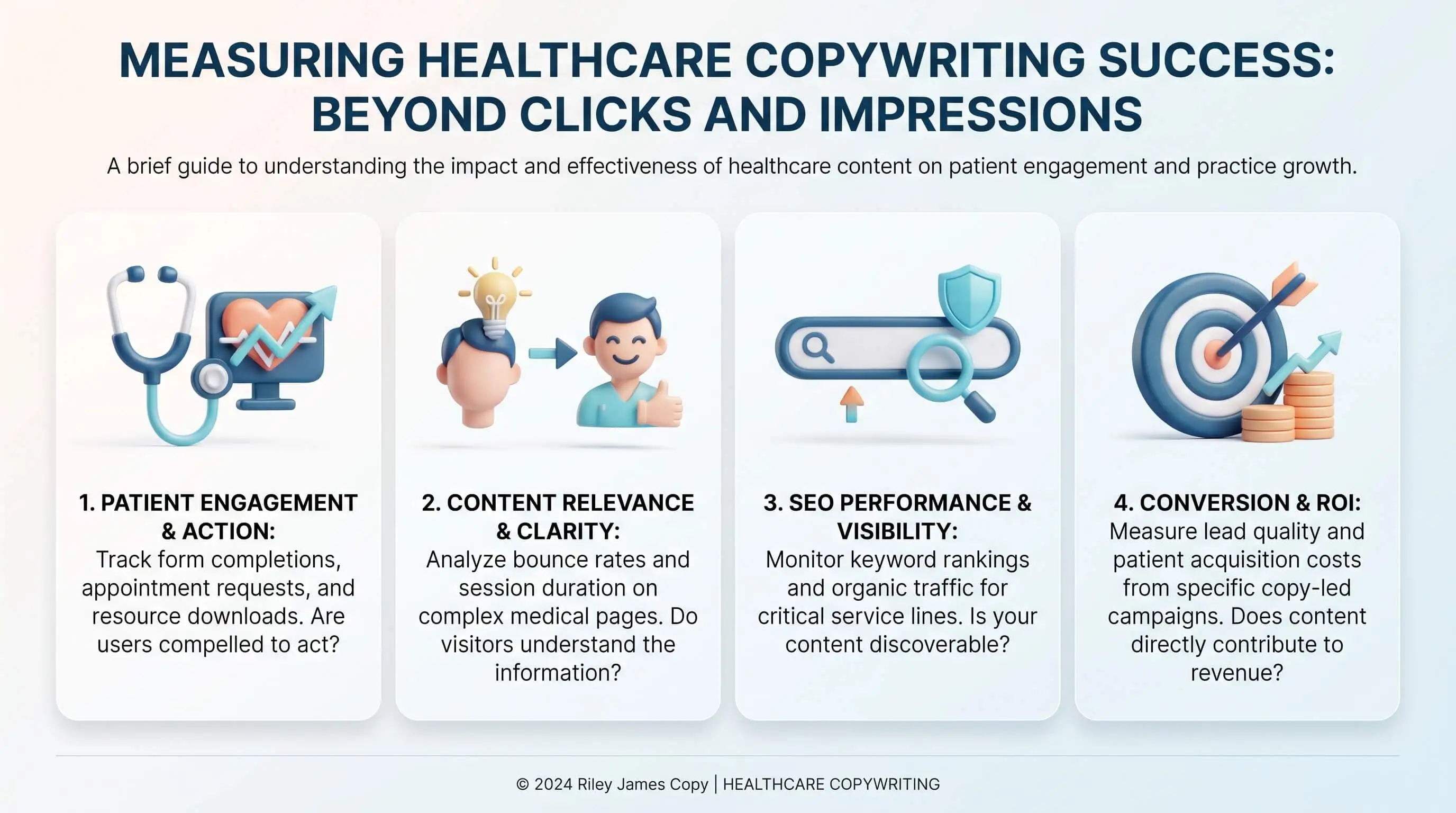
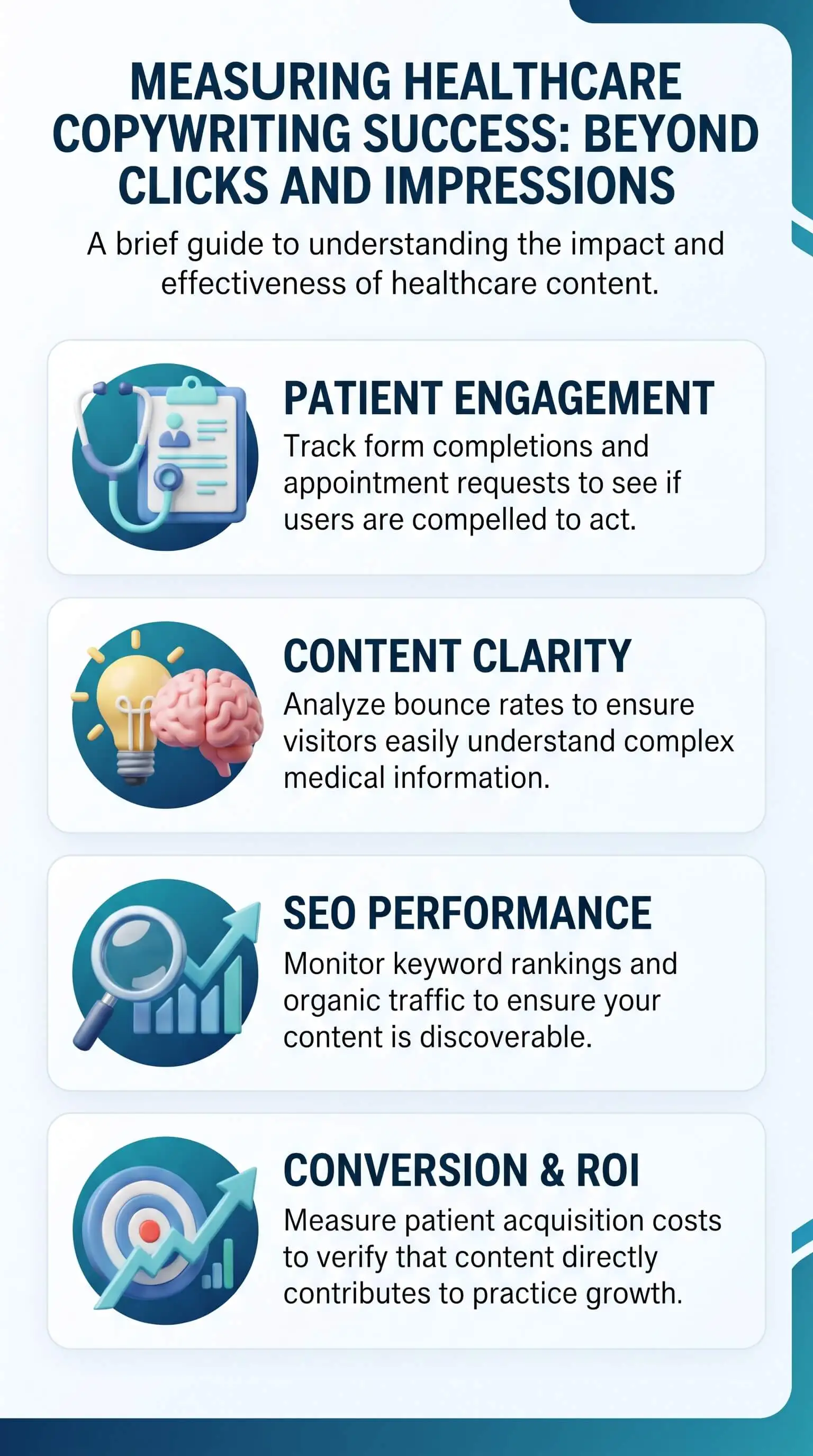
Track five metrics, not forty. Appointment requests, search visibility, engagement, lead quality, and what patients say back.
Record a baseline first. Without 90 days of "before" numbers, you can't prove the "after."
Ignore vanity numbers. Traffic, likes, and word counts can rise while your schedule stays empty.
Keep tracking HIPAA-aware. Keep patient health information out of analytics tools, and ask vendors about business associate agreements.
Why Copy Metrics Look Different For A Private Practice
A hospital system can afford a marketing department and a dashboard with 40 tiles. You've got a front desk, a few hundred website visitors a month, and a schedule that either fills up or doesn't.
So you measure differently. Good private practice healthcare copywriting covers your website, your SEO content, and your patient email, and each piece has its own job. Service pages should turn visitors into calls, while blog posts need to get found and emails need to bring people back. Judge each one against its own job, not against a report built for somebody else.
Small numbers are fine, as long as you know exactly what they mean.
The Five Metrics That Show Your Copy Is Working
Five numbers will tell you most of what you need to know. You'll find 40-metric lists online, and I'd guess half of them exist to convince you that you need an agency.
1. Appointment Requests And Calls Per Page
This is the big one. How many people who land on a page go on to call, fill out a form, or book? In Google Analytics 4, mark form submissions and phone-number clicks as key events, then check them page by page.
Skip the industry averages. Compare each page to itself, before and after the new copy went live. If your knee pain page went from two requests a month to seven, the copy did its job, whatever some benchmark report says.
2. Search Visibility For The Questions Patients Ask
Google Search Console is free, and it shows how often your pages appear in search, how often people click, and what share of searchers do. Watch those numbers for the questions your patients actually type.
Your meta title and description count as copy too. Rewriting a dull title is often the quickest win you'll get, because people click the result that sounds like it answers them.
3. Engagement That Shows People Are Reading
GA4 reports engaged sessions and average engagement time. Put together, they tell you whether visitors stay and read or leave after a line. Google's guidance on creating helpful, people-first content asks the same question in its own words: did the reader leave satisfied?
When a long page has a short engagement time, look near the top first. Usually the headline promised one thing and the first paragraph delivered another.
4. Lead Quality Over Lead Count
Ten calls from the wrong patients are worse than three from the right ones. They eat your front desk's time and book nobody. Once a month, ask your staff a couple of questions. Are callers asking about services you actually offer? Do they already know what a visit involves?
Then add one line to your intake form: "How did you find us?" You'll learn more from that question than from any tool I could recommend.
5. What Patients Say Back
This one's quiet, and it's my favorite. When a new patient tells you, "I liked that you said you actually listen," the copy landed. Keep an ear out for those echoes in reviews and intake notes.
Metrics That Look Good But Can Mislead You
Some numbers feel like progress and aren't:
Raw traffic. A page with 200 visitors that books 10 patients beats one with 2,000 that books none.
Social likes. Nice to see, rarely tied to a booked visit.
Word and keyword counts. Longer isn't better, and stuffed keywords make copy worse.
Time on site by itself. A confused visitor spends a long time on your site too.
Here's the honest version: if a number can climb while your schedule stays empty, it isn't measuring success.
How To Set Up Tracking Without An Enterprise Budget
Free tools and about 15 minutes a month will cover it:
Record a baseline. Write down 90 days of calls, form requests, and Search Console clicks before the new copy goes live. Without a before, there's no after to compare.
Set up GA4 key events for form submissions and phone-number clicks.
Connect Google Search Console and note which searches bring people to each page.
Add the intake question, with a short list of answers to pick from.
Review once a month. Same numbers, same day. You're looking for the direction things are moving.
One caution, because this is healthcare. Keep patient health information out of your analytics and ad tools. A form should never pass what someone typed about their symptoms to a tracking platform, and you'll want to ask any tracking vendor whether it'll sign a business associate agreement. HHS lays out the rules in its guidance on HIPAA and marketing. If you're unsure, run it past whoever handles your compliance.
How Long Before Copy Shows Results?
It depends on the job the copy is doing:
Website and landing pages: often a few weeks, since the traffic you already have starts converting better.
SEO content: usually three to six months to climb in search. After that, it keeps working for years.
Patient email: slow to start, then it builds as your list grows.
Nothing in marketing is guaranteed, even when following proven medical copywriting tips. Still, if nothing has moved after six months, the copy or the setup needs a second look.
What This Looks Like For A Wound Care Clinic
Say a wound care clinic publishes a page on what to expect after silver nitrate treatment, a question its patients ask all the time. Here's how the five metrics play out on that one page.
Calls and requests: how many readers go on to book a wound check.
Search visibility: which aftercare questions it shows up for, and whether people click.
Engagement: whether readers stay long enough to get through the aftercare steps.
Lead quality: whether callers now ask informed questions instead of the basics.
Patient echoes: whether new patients say something like, "I read that the dark spot was normal."
"Most practices I work with have never looked at a single page's numbers. They judge the website by whether they like reading it. When I rewrote the pages for an occupational-health clinic, we didn't celebrate the new wording. We watched which searches it showed up for and whether the phone rang. They went on to rank #1 for 33 of the searches their patients actually use, and the calls followed. So that's my test. Did the right people find you, and did they pick up the phone? If the copy is beautiful and the schedule's empty, I didn't do my job."
Essential Resources
Seven free, official guides worth bookmarking before you start measuring. If you only read two, make it the first two. They cover most of the setup.
1. Turn Calls And Form Requests Into Trackable Numbers
Google's help page walks you through marking an event, like a form submission or a phone click, as a key event in Analytics. Once it's marked, you can see which pages actually produce appointment requests.
Source: Google Analytics Help: Mark Events as Key Events
2. See Which Patient Questions Bring People To Your Site
The Search Console starter guide covers verifying your site and reading the Search performance report, which breaks traffic down by query and page. Google suggests checking in about once a month, which suits a busy practice just fine.
Source: Google Search Central: Get Started With Search Console
3. Grade Your Pages The Way Google Does
This is Google's own checklist for helpful, people-first content. Read the self-assessment questions with one of your service pages open, and the weak spots show up fast.
Source: Google Search Central: Creating Helpful, Reliable, People-First Content
4. Keep Patient Data Out Of Your Tracking Tools
HHS explains how HIPAA applies to analytics tools, pixels, and other trackers on healthcare websites, including when a vendor needs a business associate agreement. Read the banner at the top first. A federal court vacated part of this guidance in 2024, so go through it with whoever handles your compliance.
Source: HHS: Use of Online Tracking Technologies by HIPAA Covered Entities
5. Know When Patient Outreach Counts As Marketing
Before you start measuring email, learn what HIPAA treats as marketing and when you need a patient's written authorization. HIPAA treats messages about your own services differently from third-party promotions.
Source: HHS: HIPAA Privacy Rule Guidance on Marketing
6. Write Copy Patients Understand The First Time
The CDC's plain-language page includes a short checklist. Put the most important message first, use "you," and keep sentences to about 20 words. Clearer copy tends to show up as better engagement numbers.
Source: CDC: Plain Language Materials and Resources
7. Tie Your Copy Spend To A Simple Marketing Plan
The SBA recommends comparing what you spend on marketing with the revenue it brings in, and reviewing your plan at least once a year. That's a sturdy way to decide whether your copy is earning its keep.
Source: U.S. Small Business Administration: Marketing and Sales
Supporting Statistics
Three numbers worth knowing before you decide measurement isn't worth 15 minutes a month. Each comes from a different research source.
1. Most Health Searches Start At A Search Engine
Among people who looked online for health information, 77% said their last search started at a search engine like Google. That's why Search Console belongs on your short list. It shows whether your copy is in the room when the search begins.
Source: Pew Research Center: Health Online 2013
2. Patients Are Already Online, And Many Reach Out There
From July to December 2022, 58.5% of U.S. adults used the internet to look for health or medical information, and 41.5% used it to communicate with a doctor or doctor's office. Your website is often the first stop before that call, and sometimes the last.
Source: CDC/NCHS Data Brief No. 482: Health Information Technology Use Among Adults
3. Nearly Half Of Adults Struggle With Health Information
The Institute of Medicine found that nearly half of American adults, about 90 million people, have trouble understanding and using health information. It's a 2004 figure, but it still explains a lot of short engagement times. When readers bail early, confusing copy is a likely suspect.
Source: National Academies: 90 Million Americans Are Burdened With Inadequate Health Literacy
Research shows that 77% of online health information seekers begin with a search engine, 58.5% of U.S. adults search online for health information, and nearly half struggle to understand medical content, highlighting the importance of clear healthcare copywriting that helps patients understand treatments like silver nitrate while improving search visibility and patient engagement.
Final Thoughts And Opinion
This is what years of watching practices judge their websites on gut feel has taught me.
You don't need a dashboard with 40 tiles. You need five numbers and a 90-day baseline, plus 15 minutes a month to look at them. Most practices never set up even that much, so the ones that do get a real edge. They know which pages earn patients and which ones just sit there looking nice.
A couple of patterns I keep running into:
Practices that track calls per page fix the right page first instead of rewriting the whole site.
Practices that judge copy by traffic alone usually end up buying more traffic, not more patients.
My take, plainly: in private practice healthcare copywriting, the one metric that counts is a booked appointment from the right patient. Everything else is a clue pointing toward it. Watch the clues, but keep your eye on the schedule.
Frequently Asked Questions
Q: What Is The Most Important Metric For Healthcare Copywriting?
A: Appointment requests and calls per page. Traffic and rankings matter because they lead there, but a booked visit from the right patient is the clearest proof the copy did its job.
Q: How Do I Know Whether My Copy Or My Ads Brought In A Patient?
A: Check which page the patient landed on and how they got there. GA4 shows the traffic source for each key event, and an intake question like "How did you find us?" catches what the tools miss.
Q: Is It HIPAA Compliant To Track Visitors On A Medical Website?
A: It can be, if patient health information stays out of your tracking tools. Don't send form contents or symptoms to analytics platforms, ask vendors about business associate agreements, and review the HHS guidance with whoever handles your compliance.
Q: What Is A Good Conversion Rate For A Medical Practice Website?
A: Honestly, your own baseline matters more than any industry average. Practices differ too much by specialty, location, and traffic source for one number to mean much. If a page converts better after a new copy than it did before, that's a win.
Q: How Often Should A Private Practice Review Its Copywriting Metrics?
A: Once a month is plenty. Pick the same day, look at the same five numbers, and watch the direction over three to six months instead of reacting to one slow week.
Start Measuring Your Copy This Week
Pull your last 90 days of calls and form requests this week. That's your baseline, and you'll have it before you change a single word. Then pick one page, track it for a month, and let your schedule tell you what's working. If you'd rather hand the writing to someone who measures it, that's exactly what private practice healthcare copywriting and medical healthcare copywriting services are for.
